California jet fuel decarbonization hits turbulence

Houston, 5 April (Argus) — Airports have joined airlines in asking California to throttle back plans to require lower-carbon jet fuel in the state.

California Air Resources Board (CARB) staff proposed requiring jet fuel used on intrastate flights to meet carbon intensity reduction targets under the state’s Low Carbon Fuel Standard (LCFS) as part of a rulemaking proposal published in December. But experts, including proponents of renewable jet fuel, warn airport infrastructure would not allowtracking fuel blends by flight.

“It’s not possible,” said Kristi Moriarty, a senior engineer for the Center for Integrated Mobility Sciences at the National Renewable Energy Laboratory. “For California airports, you have to do an accounting exercise.”

LCFS programs require yearly reductions to transportation fuel carbon intensity. Higher-carbon fuels that exceed these annual limits incur deficits that suppliers must offset with credits generated from the distribution to the market of approved, lower-carbon alternatives.

CARB considered setting standards for jet fuel before exempting the fuel from obligations in a 2019 rulemaking. Staff renewed the idea for this rulemaking for fuel burned in flights between California airports beginning in 2028. Inclusion would help meet state goals to satisfy up to 80pc of aviation fuel demand with renewable liquid jet fuel by 2045, staff said.

Some fuel producers encouraged regulators to impose the standards even faster to help make renewable synthetic aviation fuel (SAF) more competitive with renewable diesel and hydrogen.

“The slow uptake of SAF in California can be traced, in part, to state regulatory rules, including the lack of an obligation on fossil jet fuel under the LCFS,” a coalition including Darling, Green Plains and LanzaJet told the board.

Airline trade groups have repeatedly warned that approach would land in court. The Federal Aviation Administration (FAA) governs US jet fuel specifications, preempting even the US Environmental Protection Agency. FAA in turn sets its standards by specifications determined by engine manufacturers. Current regulations allow 10-50pc blends of renewable synthetics to produce finished, on-specification jet fuel.

Comments focused less on whether the plan was physically possible. Airports, like many retail gasoline stations, receive bulk, on-specification fuel blended upstream in the supply chain for just-in-time delivery. Fueling infrastructure may sit on airport land, but it is run separately from other airport operations.

“I am not aware of any airports in North America, or even in the world, that are currently receiving and doing on-site blending of SAF,” San Francisco International Airport sustainability and environmental policy director Erin Cooke said.

Special, one-off flights could receive boutique blends delivered to specific planes. But at scale, SAF blended to specification upstream mingles with the rest of the airports fuel for delivery as needed. The alternative would require additional tanks, testing and time that schedule-crunched flights do not have, Cooke said. Representatives for county airports warned regulators that they could not afford such investments.

“Implementing this proposal could impose substantial operational burdens on county airports, potentially disrupting the progress toward our state’s sustainable aviation future,” the California State Association of Counties warned CARB.

CARB did not address questions this week on how regulators saw the plan working.

San Francisco International did not take a position on the current proposal. The airport would welcome tools to better track and understand rising SAF use, she said.

“But in terms of actually tracking the direct fuel and its uplift to an aircraft serving a domestic or California market — I honestly do not know how you would do that,” Cooke said.

Regulators could address that by allowing the use of book-and-claim to shed more light, indirectly, on the volumes of fuels that individual customers bring into the overall system, Cooke said. It’s a system that World Energy, a supplier of renewable jet fuel to Los Angeles International Airport, would prefer, president Scott Lewis said.

“We do not want to get between CARB and our customers, because I think that it runs the risk of being confusing,” Lewis said. “I am just concerned about losing the plot.”

Book-and-claim allows detailed accounting for the purchase and transfer of renewable fuels by parties that may not ultimately receive the molecules they acquired. It aligns with a system of offering closely-tracked carbon reductions for airlines or for their customers — major corporations that might include air travel in their overall carbon footprint goals, Lewis said.

“We need to show that the customers that are acquiring these are getting something for it, and they are willing to pay for it,” Lewis said. “Airlines don’t consume fuel for themselves, they consume it to fly planes with people in the seats.”

By Elliott Blackburn
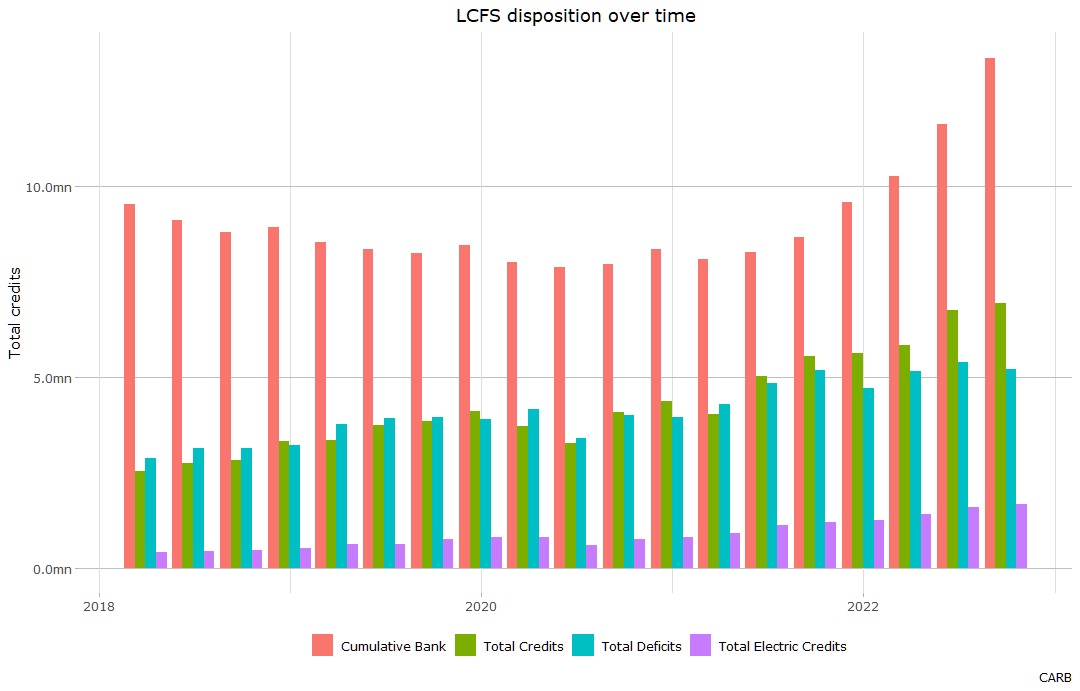
Chart of LCFS new credits, new credits, new electric charging credits, and available credits since 2018, showing rising unused credit volumes.

California posts new record LCFS credit build

A record build pressures LCFS prices. Available to read at and property of ArgusMedia.com.

A second consecutive record build in California Low Carbon Fuel Standard (LCFS) credits added pressure to spot and forward markets today.

New LCFS credits outpaced program deficits by a record 1.7mn metric tonnes (t) in the third quarter of 2022, building unused credits available for compliance to 13.4mn t, according to California Air Resources Board (CARB) data released today.

New credits have exceeded deficits for six consecutive quarters, and posted new record increases for the past two. The rising volume of credits that can be used to comply with state mandates and do not expire have raised alarms from renewable fuel producers seeking tougher new standards for one of the top low-carbon fuel markets.

LCFS programs require yearly reductions in transportation fuel carbon intensity. Conventional, higher-carbon fuels that exceed the annual limit incur deficits that suppliers must offset with credits generated from the supply of approved, low-carbon alternatives.

Rising supplies of these low-carbon fuels have met sluggish demand for California’s gasoline blendstock and largest LCFS deficit source, CARBOB. The fuel still generated 79pc of all new deficits during the third quarter, even as overall consumption fell by 3.1pc from the previous quarter and by 8.5pc from the third quarter of 2021. Petroleum diesel consumption fell by 29pc from the third quarter of 2021.

Deficits generated from the consumption of petroleum gasoline and diesel in the state fell by 3.5pc from the previous quarter as demand for both shrank during the period.

Credit generation meanwhile continued to climb, up by 2.7pc from the previous quarter, as renewable natural gas, ethanol and electric vehicle charging all produced more credits than in the previous quarter.

Renewable diesel credits meanwhile shrank, as smaller volumes of higher-carbon production found their way to the state during the quarter. Both used-cooking oil- and tallow-based renewable diesel consumption exceeded volumes in the third quarter of 2021 but fell by a combined 22pc from the previous quarter. Corn oil-based renewable diesel increased sharply. Renewable diesel remained the leading source of new credits, at 39pc of all generated during the third quarter of 2022.

Lower, longer

California LCFS credit prices have groaned under the weight of record supplies. Credits do not expire, and so parties may use the growing bank of untapped credits to meet current and future obligations.

Spot credits that traded around $200/t in January 2021 slumped to a six-year low in September 2022, near $60/t. Spot credits have traded between $60-70/t since then, even as CARB reported the previous 11.3mn t record volume of unused credits at the end of October.

Credits immediately sank following the data release early in the second half of today’s trading session. Bids for prompt through second quarter 2023 credit transfers briefly dipped to $58/t.

Renewable fuel suppliers have clamored for CARB to respond to the rising unused credit volume with tougher targets. CARB staff have said that a rulemaking to consider revisions to the LCFS would begin early this year.

By Elliott Blackburn

Sources of rising LCFS credits over time

Argus: Outlook on California’s low-carbon fuel policy

This 2021 viewpoint examined the forces pulling down prices for California’s Low Carbon Fuel Standard (LCFS), a state program forcing reductions to the carbon intensity of transportation fuels supplied to the largest US market. You can read this (as of early 2022) and other analysis at ArgusMedia.com.

Viewpoint: RD, fuel demand weigh on California LCFS

New low-carbon fuel supplies will add pressure in 2022 on California Low Carbon Fuel Standard (LCFS) credits already trading near three-year lows.

California this year recorded some of the nation’s largest drops in transportation fuel demand compared with pre-pandemic levels in 2019. The slump in associated LCFS deficits helped push spot credits down nearly 30pc this year, dropping in November to their lowest levels since 2018. Federal mandates and US refiner strategies threaten to deluge California with renewable diesel credits in 2022.

A $1/USG federal blending tax credit offers a first layer of support for biodiesel and renewable diesel (RD). Proposed federal Renewable Fuel Standard (RFS) mandates for 2022 will add a second.

The US Environmental Protection Agency (EPA) projects that refiners, importers and other obligated parties will rely on renewable diesel and biodiesel to meet a 21bn ethanol-equivalent USG renewable fuel blending requirement for 2022. The price for credits associated with biodiesel and renewable diesel used to comply with the RFS have averaged about $1.54/USG since EPA proposed the mandates earlier this month, compared with about $1.03/RIN in January.

Low-carbon crosshairs

California’s LCFS and Oregon’s Clean Fuels Program complement the LCFS with an additional layer of incentives. While the RFS mandates minimum volumes, LCFS programs set a maximum carbon intensity for transportation fuels each year. Fuel distributors supplying low-carbon fuels including renewable diesel and biodiesel receive credits that offset deficits incurred by conventional, higher-carbon fuel.

The combination of compliance incentives and significant fuel demand has kept California lucrative for renewables. California accounted for more than 60pc of US renewable diesel blending in 2020, based on EPA and state data. That increased to 70pc of renewable diesel blended in the US through the first half of this year.

California LCFS credit prices began sinking in August. Credit generation climbed faster than the state’s transportation fuel demand after business and travel restrictions imposed to limit the spread of the coronavirus in 2020. That imbalance lingered, even as the state eased restrictions.

California has consistently reported one of the five largest deficits to 2019 gasoline demand in all but one of the first nine months of the year, according to EIA data. State data show that September taxable gasoline volumes supplied fell to a more than 20-year low, trailing the same month of 2019 by 7pc. CARBOB represented almost 80pc of all LCFS deficits generated in the second quarter, the most recent period for which data are available.

The official balance of LCFS credits and deficits for the third quarter will be published at the end of January. But third quarter taxable gasoline gallons fell by 12pc compared with 2019. Taxable gallons have closely tracked volumes associated with official LCFS deficits, falling within 0.7pc of the second quarter California Air Resources Board (CARB) data.

Lower and lonesome

Some producers have urged CARB to halt the drop in credits to signal support for long-term investments needed to deliver low-carbon fuels. California and Oregon cap credit prices, but regulators for both states have said they will not set a floor.

Low credit prices indicate room for tougher standards, regulators said. But neither program can lower targets quickly.

Because any new LCFS standards must align with ongoing, broader updates to California’s policies on climate change, new targets will not be implemented before 2024, CARB staff said.

Lower credit prices could offer some long-term advantages, Darling Ingredients chief executive Randall Stuewe said this month. Darling partnered with US independent refiner Valero on the largest US renewable diesel producing joint venture, Diamond Green Diesel, and processes renewable feedstocks as part of its core business.

Prices well below their maximum levels will help LCFS programs spread to new markets and set tougher future goals, he said.

“That gives regulators the courage to accelerate the trajectory of decarbonization,” Stuewe said.

Other North American markets are pursuing their own LCFS programs. Washington state regulators are crafting rules for a program legislators approved earlier this year, which could start in 2023. Canada also continues to refine its Clean Fuel Standard, an LCFS program that could begin trading in early 2023. Minnesota, New York, New Mexico and other states have all considered adopting similar programs for their markets.

But the status quo of California’s leading incentives and lagging demand will keep the state flush with credits in 2022.

US gasoline cracks fall to negative territory

Read this at ArgusMedia.com: Published date: 17 March 2020

Benchmark gasoline prices fell below regional crude settlements yesterday in major US fuel markets, a rare spring inversion responding to the demand destruction of a global effort to contain the spread of the new coronavirus.

Regional sweet benchmark crudes settled higher than corresponding gasoline benchmarks in the US Atlantic, Gulf and west coasts and the midcontinent, based on Argus assessments. Gasoline in each case was worth less than a barrel of certain sweet crudes purchased to produce it. The fuel retained a premium to sour crude benchmarks in the US Gulf coast, midcontinent and in the Los Angeles, California, market. Overall refining crack spreads — a measure of refinery profitability — were sharply lower but kept positive on the strength of diesel margins.

Cities have ordered residents to shelter in place, states have closed restaurants and bars, and the federal government yesterday urged anyone able to work from home for the next two weeks to do so to limit the spread of the coronavirus. Deep cuts to gasoline consumption were inevitable, though not yet quantified by the Energy Information Administration.

The gasoline discounts to crude happen occasionally, including last February in the New York Harbor, US Gulf coast and midcontinent markets. The reversal more often occurs in January or February, when US gasoline demand shrinks. But they last happened at the same time across these four regions in December 2014.

A barrel of Buckeye RBOB in the New York Harbor fell to a $3.23/bl discount to Brent. Colonial M grade conventional gasoline fell to a 56¢/bl discount to WTI Houston and a 36¢/bl discount to Light Louisiana Sweet (LLS). San Francisco CARBOB dropped to a 18¢/bl discount to Alaskan North Slope (ANS). No market began March below a $5/bl premium to their respective regional crude.

Diesel premiums to crude settled yesterday above the five-year weekly average in the Atlantic and west coasts. But refinery margins yesterday settled at least 50pc lower than that same five year average period in every region.

The Nymex April RBOB contract settled today at 71.14¢/USG, higher by 2.15¢/USG than the previous settle. Regional differentials to that benchmark were falling in the US Gulf coast, Chicago and San Francisco markets. New York Harbor Buckeye RBOB was slightly higher from yesterday’s midpoint in afternoon trade.

By Elliott Blackburn

Renewable diesel makes inroads in California

Production of California’s boutique diesel fell last year to the lowest levels in decades as renewable alternatives gained market share in the state.

In-state output of diesel approved for California roads plunged to the lowest fourth quarter volume on record last year, according to the California Energy Commission (CEC), despite available tax data suggesting higher overall diesel consumption. Refiners meanwhile boosted production of non-California diesel to the highest levels in at least two decades and ramped up exports of fuel oil.

Renewable diesel, an alternative diesel that blends seamlessly with its petroleum-based cousin, rapidly grew its market share in the state transportation pool as the mix of diesel supply flipped, according to the California Air Resources Board (CARB). The shift illustrates how US refiners have adapted asa major market seeks to slash their traditional products.

“When we look at opportunities to produce products where there is going to be growth in the market and they are going to have sustainably high margins, we look to renewable diesel,” Valero chief executive Joe Gorder said in October.

CARB crash

California refiners had not since 2003 produced less than an annual average 200,000 b/d of diesel approved for the state’s roads, called CARB diesel. The stretch dated back to before California’s modern fuel requirements took effect. Average production in 2019 fell by a third from 2018, the largest year-to-year decline on record and more than double a 2009 drop as the state navigated a recession.

But California diesel demand was steady for much of 2019, according to a combination of state and federal data. Taxable gallons recorded by the most recent California Department and Tax and Fee Administration data show a 1.3pc increase, to 204,000 b/d, through the first nine months of the year. While short of the more than 2pc increases in implied demand seen for three consecutive years for the same periods in 2015, 2016 and 2017, the modest increase reversed a decline in 2018.

Fuel prices over the course of the year also cannot fully explain the shift, based on Argus assessments. San Francisco CARB and non-CARB diesel were at parity for almost all of 2019, while the Los Angeles market offered a steady premium for CARB fuel. That premium narrowed over the course of the year to within a 7¢/USG range from the previous year’s 9.5¢/USG premium.

Renewable diesel surge

Credit prices to comply with the state’s green fuel standard moved more dramatically. Renewable diesel supported by the state’s Low Carbon Fuel Standard took steadily larger bites of state fuel demand. The fuel, which blends seamlessly with petroleum diesel and can use existing pipelines and other infrastructure, accounted for 10.2pc of the California diesel pool in 2018. Renewable diesel increased that share by more than 60pc to 17.2pc in the first half of 2019, racing past biodiesel as the lead diesel alternative.

Credit prices over the same period increased the spread between average California renewable diesel credits and conventional diesel penalties by almost a third. That gap has doubled since 2017.

US independent refiners Marathon Petroleum, Phillips 66 and Valero and majors Shell and BP have all planned renewable diesel projects. Oil majors Shell and BP have also planned west coast renewable diesel plants. Independent refiner PBF Energy plans to join a proposed Shell plant at the 155,000 b/d Martinez refinery that PBF plans to buy from the major during the first quarter.

Valero already operates an 18,000 b/d renewable diesel plant in Louisiana that it plans to expand to 44,000 b/d in 2021. California’s commitment to the program, along with rising interest in the fuel in Canada, Europe and New York, supported investments in the fuel, Valero senior vice president of alternative fuels Martin Parrish said during a third quarter conference call.

“We think the future demand for renewable diesel just looks very strong,” Parrish said.

New focus

But California refiners did not ramp down overall diesel production, according to the CEC. Non-California diesel production climbed above 200,000 b/d for the first time in CEC records, and stayed there through the last three quarters of 2019. Output of non-California diesel consistently surpassed CARB diesel production for the first time since CEC records began in 1999.

Refiners and traders have not discussed where that production flowed, and federal and state data does not give a complete picture of consumption in neighboring states.

State tax records show that Nevada diesel and biodiesel consumption increased by almost 5pc in the first 10 months of 2019 compared to 2018. Both Los Angeles and Utah supply that state. Arizona state fuels information was not available, and federal data offers only an incomplete estimate of higher consumption for 2019.

Federal export data and vessel tracking by analytics firm Vortexa show fairly typical diesel exports from California over 2019. But fuel oil exports loading from California began ramping up beyond year-ago levels in August as diesel exports shrank, according to Vortexa.

EPA grants 31 Renewable Fuel Standard waivers

Prices for US renewable fuel blending credits plunged today ahead of the Environmental Protection Agency’s (EPA) approval of 31 exemptions for small refineries of their federal biofuel obligations for 2018.

The agency rejected six of the 2018 applications and the single remaining applications for the 2016 and 2017 compliance years. The decisions marked the first rejected requests to waive Renewable Fuel Standard (RFS) requirements under President Donald Trump’s administration and since 2016.

A final 2018 application was withdrawn.

The decisions effectively waived 7.4pc of the requirements for the 2018 compliance year, freeing up credits needed to comply for future years of the program. Farm and biofuels groups immediately condemned the announcement, which arrived three weeks late and followed a heated summer of debate over EPA’s administration of the mandates.

Prices for ethanol-associated renewable identification numbers (RINs) traded as low as 11¢/RIN this afternoon ahead of the statement, down from a 20¢/RIN settle yesterday, based on Argus assessments.

“The EPA has proven beyond any doubt that it does not care about following the law, American jobs, or even the president’s promises,” ethanol trade group Growth Energy chief executive Emily Skor said. “Now farmers and biofuel producers are paying the price.”

RFS requires that refiners, importers and certain other companies each year ensure minimum volumes of renewables enter the gasoline and diesel they add to the US transportation fuel supply. Refiners prove annual compliance with renewable identification numbers (RINs) representing each ethanol-equivalent gallon of blended fuel acquired through their blending businesses or by purchasing the credits from others.

Congress included an exemption for refineries processing less than 75,000 b/d of crude a year that could demonstrate a hardship under the program to the Energy department and EPA. EPA issued relatively few such waivers under former president Barack Obama’s administration, but their use surged under Trump’s first EPA administrator, Scott Pruitt, and following a series of judicial rebukes of the difficult Obama administration criteria.

These waivers effectively reduce total annual mandates because the EPA does not shift the waived requirements to other, larger obligated parties. A record 35 waivers issued as of March this year for 2017 reduced obligations for that compliance year by 9.4pc.

Exemptions for the 2018 compliance year waived 1.43bn RINs.

Ethanol advocates have especially railed against the waivers, insisting the exemptions slashed demand for their fuel and associated corn feedstock as Trump’s trade wars and widespread flooding crush farm incomes this year. The waivers have more directly affected biodiesel blending refiners historically used to make up the difference between the total volume of annual ethanol demand and mandated renewable blending volumes.

Refiners have argued that the courts determined EPA was only now properly issuing waivers.

“Capital planning is difficult without knowing whether your refinery needs to set aside millions of dollars for RIN purchases,” the Small Refiners Coalition said. “The decision to grant small refinery hardship is a legal decision, not a political one, and we are pleased that [the department of Agriculture’s] influence did not cause EPA to depart from the rule of law.”

EPA pledged to “remove regulatory burdens” for new pathways of renewable fuels to use to comply with the program, and touted work with the National Corn Growers Association to expedite approval for the herbicide atrazine.

“EPA is committed to an expeditious and transparent process to ensure that America’s corn growers have the tools they need to grow safe, healthy and abundant food for all Americans and a growing population,” the agency said.

Litigation continues against EPA’s handling of the program. The US Court of Appeals has scheduled a late October hearing on an Advanced Biofuels Association challenge to the agency’s use of the program.