scorched range

Scorched Earth

US | Tue May 24, 2011 8:46pm EDT

Drought and fire jeopardize ranching lifestyle in Texas

LUBBOCK, TEXAS | BY ELLIOTT BLACKBURN

A miserable sea of dry brown West Texas grass and charred scrub could cripple ranching operations in the country’s top beef-producing state.

“Right now, it’s literally day-to-day, and Mother Nature’s holding all the cards,” said Dennis Braden, general manager of the 130,000-acre Swenson Land and Cattle Co.

In the state where cowboys riding the open range on horseback herding cattle spawned a whole western culture, modern-day ranchers are hurting.

Severe drought and millions of acres of wildfires have delivered a potent one-two punch this year, forcing tough decisions on ranchland across Texas.

The state’s livestock industry has lost $1.2 billion under withering conditions, according to the Texas Agrilife Extension Service, part of Texas A&M University.

It’s a bitter pill for Braden and the more than 120-year-old ranch located 170 miles west of Fort Worth.

In Texas and other states with large cattle herds, the beef industry chain starts at the ranch. Farmers own a herd of beef cows, each of which gives birth to a calf in a typical year. The mother nurses the calf and the pair graze on grass all summer, fattening up the calf for market. The young calves are eventually weaned from their mothers and sent to feedlots to be fattened on grain for slaughter.

This year, ranchers should be reaping the benefits of high prices, low supplies and high demand for their beef

The demand from for calves from feedlots, where cattle add hundreds of pounds before slaughter, seems insatiable. The Swenson ranch entered this season planning to grow by thousands of cattle over several years.

But he and other calf growers instead spent this spring in a desperate hunt for pastureland and contemplating selling all of their livestock.

His ranch has seen more fire than rain since September. Wildfires roared out of a canyon and went on a 35-mile march across his and neighboring remote ranchland in April, consuming thousands of acres of mesquite and pasture.

Cattle subsisted on dead grass as his cowboys worked to keep the cattle healthy enough to bear new calves.

West Texas did not have the water to irrigate hay, and thousands of acres of drought-ridden wheat fields never produced a crop.

If conditions do not improve by August, he will run out of even low-quality feed for his herds, he said.

“We don’t have the grass resources to keep those calves around,” Braden said.

Fire alone will not devastate a ranch, and managers may often use controlled burns to improve the range. A good blaze can clear away the tall, dead brush hiding the green grass that helps bulk up the herd.

Emerald fuzz covered scorched patches of Swenson ranch after less than an inch of rain provided the area’s first shower in nine months.

Given a good spring storm, the tough, hilly scrub would look like Ireland, Braden said. But the most recent shower was not near enough to break the drought.

Without acres of green, protein-providing grass, cows will struggle for nutrients. The herd will lose interest in breeding and cows will not even provide enough milk to their own calves, bringing the first step of America’s beef cycle to a halt.

The outlook for more rain looks grim. The National Weather Service’s Climate Prediction Center forecast below-normal rainfall for Texas over the next month at least.

The cash-green carpet that sprang up from wildfire ash could brown under the Texas sun.

“Couple of days of 40 mile-per-hour winds and 100-degree temperatures and it will go back to buckskin,” Braden said. Ranches that could afford it hunted for rare acres of pasture outside the state.

Joe Leathers, manager of the historic 6666 Ranch in Guthrie, about 100 miles east of Lubbock, had moved cattle to New Mexico to keep a prized genetic line alive.

He could not consider liquidating the herd with ranch families and years of breeding programs depending on him, he said.

“If you had to sell your herd off and wait until it rains, you’re going to have 75 families out of a job, and a home,” Leathers said.

“It sure would be nice if it rained,” said David Anderson, a livestock agronomist with the Texas Agrilife service.

(Editing by Corrie MacLaggan and Greg McCune)
accounted 4

Small Victories

Find this at Reuters.com.

Perfect strangers friends for life after Joplin tornado

Autumn Achey

By Elliott Blackburn

JOPLIN, Mo | Sun May 29, 2011 10:30am EDT

(Reuters) – Melody Dickey doesn’t remember the tornado hurling her car the length of three football fields or calling out for her nine-year-old daughter Autumn, who was ejected as it rolled.

But she had no trouble at all on Friday recognizing the voice of the stranger who tied the tourniquet on Autumn’s badly cut leg and carried her daughter to safety.

One week after a huge tornado ripped across this Missouri town of 50,000, authorities are still searching for 100 people listed as missing or unaccounted for.

Two families conducted a different kind of search over the week, trying to find perfect strangers brought together by one terrifying night.

Jimmie Joe Zaccarello, 49, had just survived a record tornado crushing like a trash compactor the Home Depot store where he worked. He crawled to safety through spaces in the collapsed steel roof outside.

He was told to stay put, he said, and be counted. But he walked away to offer help.

“The people I kept coming across were the deceased, and it was just horrible,” Zaccarello said. “Finally I found somebody alive, that I could do something, to try to help.”

accounted 4
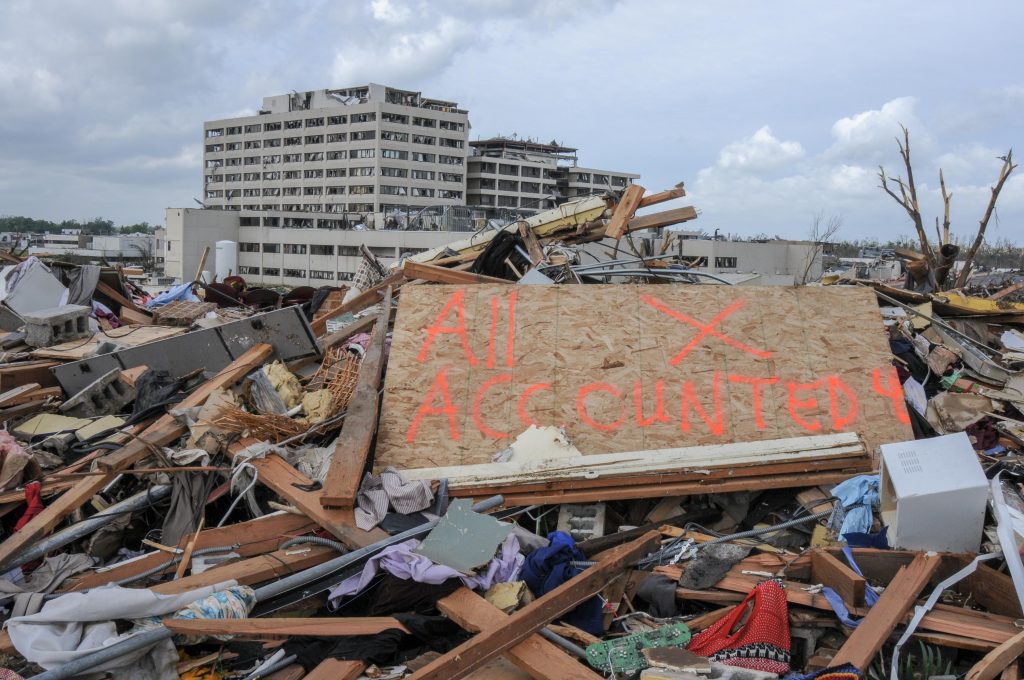
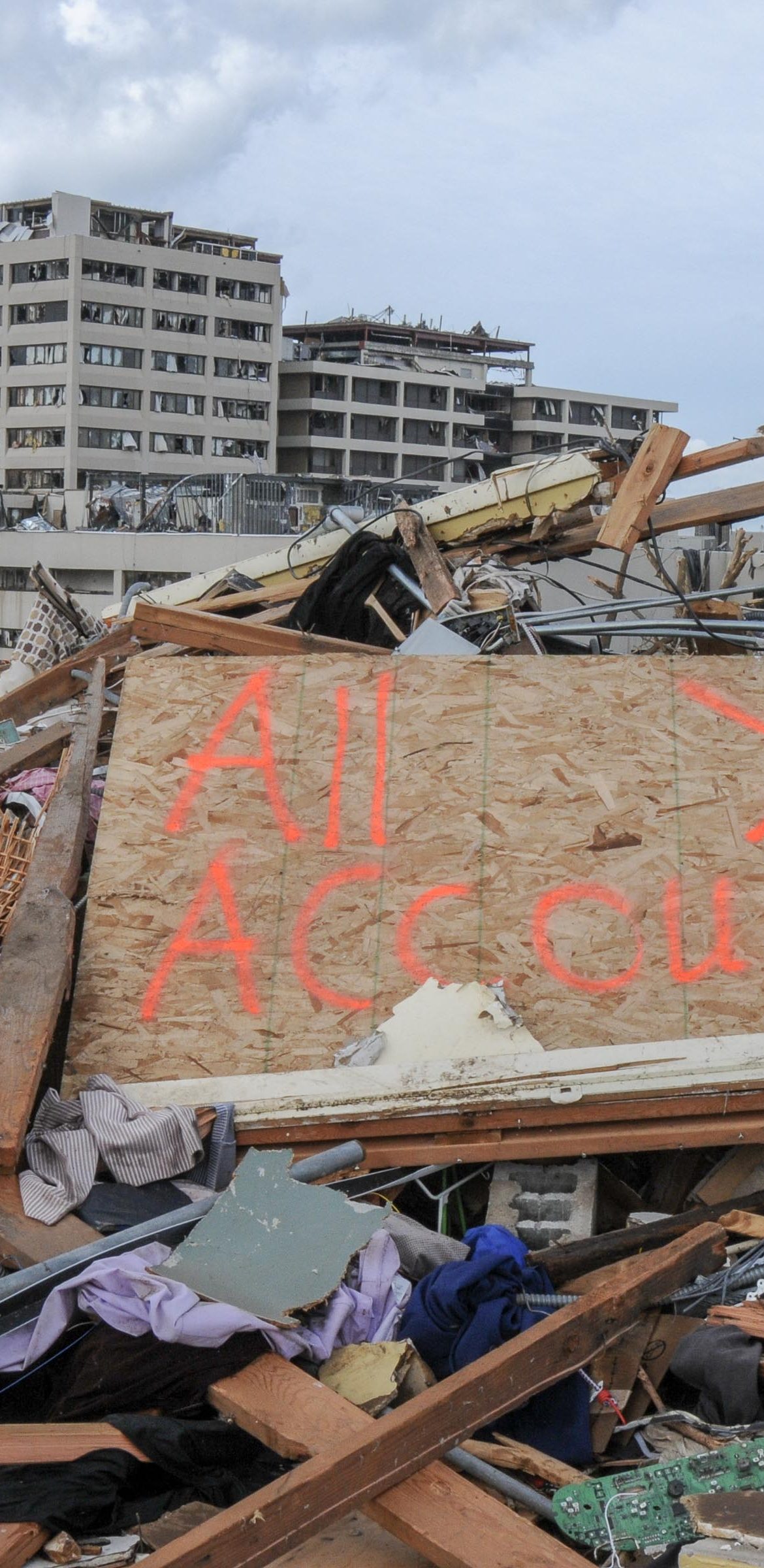
A destroyed home near a ruined hospital in Joplin, Missouri, 2011.

Melody Dickey and her daughter Autumn Achey left a trailer to rush to the safety of a best friend’s house when the storm caught them.

They were stuck behind a slow moving truck. Dickey honked her horn, frustrated, when there was a sudden calm.

“There was no wind, there was no rain, there was nothing,” Dickey said. “The last place I remember the car being was down by Home Depot.”

Autumn remembered debris bursting through the rear windows. Melody remembered rolling, but not for how long.

“I just told Autumn to hold on, I think,” before her daughter slipped from under the seatbelt and out of the car, Dickey said. “That’s all I could think about. Autumn was gone. There was no way she could have lived through it.”

Autumn remembered sliding out of the car and covering her head, protecting herself from the storm. She hefted a large piece of metal debris off her back and called for her mother.

“I was just thinking ‘I hope Mom’s here,’” she said. Two large gashes had opened in her leg.

“Looked like a man took an ax to it,” Zaccarello said.

Autumn was covered in mud and blood. She could hear her mother call her name, and followed it, limping along.

They were the first living survivors Zaccarello found.

“He just walked right up and picked her up,” Melody said.

The short, wiry flooring specialist tore his shirt to tie a tourniquet on her leg. He could barely heft the little girl, but he struggled his way to emergency help, and angrily demanded they take her mother, too. Melody Dickey’s back was black with bruises and her shoulder dislocated.

And for nearly a week, that was the last they saw of each other.

Autumn’s father, Jim Achey, wandered the wreckage for hours that night before Melody could send him word where they were. The next person he wanted to find was the man named Jimmie who helped his family.

Zaccarello needed to find the family, too. His home and family passed the storm unscathed. But he’d lost a home in a fire in 2005, and a daughter to liver disease in 2006, he said.

He was depressed, thinking of all the death and destruction he saw Sunday, and desperate to know the little girl he helped — just two years older than his granddaughter — had made it through the storm.

“I’ve just lost so much,” Zaccarello said.

He called the local radio station, which has broadcast round-the-clock calls seeking friends, family, volunteers and places to drop donations. He choked up at times as he described his story.

A friend told Jim Achey about the call. They rushed to find a radio at the hospital. Melody knew Zaccarello’s voice instantly.

So Friday afternoon, a beaming Zaccarello and a tough, shy and exhausted Autumn had their reunion in the pediatrics ward of the town’s remaining hospital. She was cut and bandaged, and her leg hurt too much to walk. But she was safe.

“I just wanted something positive to come out of it, you know?” Zaccarrello said.

“It’s definitely positive, man,” Jim Achey said, tearing up. “You’ve got a friend for life.”

(Editing by Greg McCune and Jerry Norton)

ruined corner

The storm’s aftermath

Joplin prepares for grim task of funerals

By Elliott Blackburn

JOPLIN, Mo | Sat May 28, 2011 11:35pm EDT

(Reuters) – For some families, goodbye to victims of a powerful tornado that crushed buildings like twigs may only be a glimpse of a hand.

Traumatic injuries to the remains of the dead could force families to dispense with the tradition of a public viewing in this small Midwestern city. State officials said Saturday the temporary morgue in Joplin included partial remains.

The grim and daunting task facing the city’s three funeral homes, and some in surrounding communities, was preparing for memorial services and for burial or cremation of at least 139 victims.

“All we can do is take our time,” said David Dillon, a former owner of Thornhill-Dillon Mortuary.

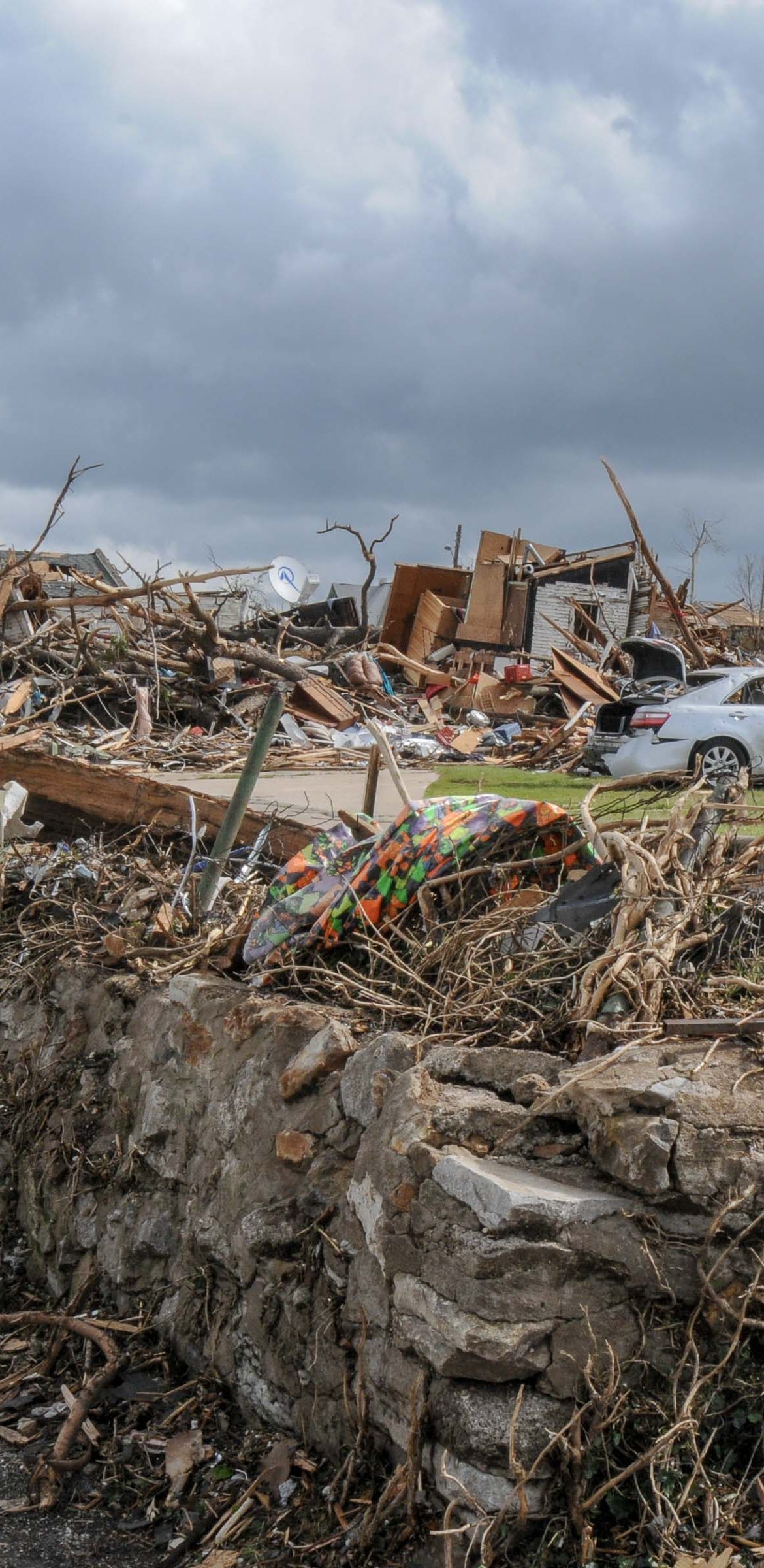
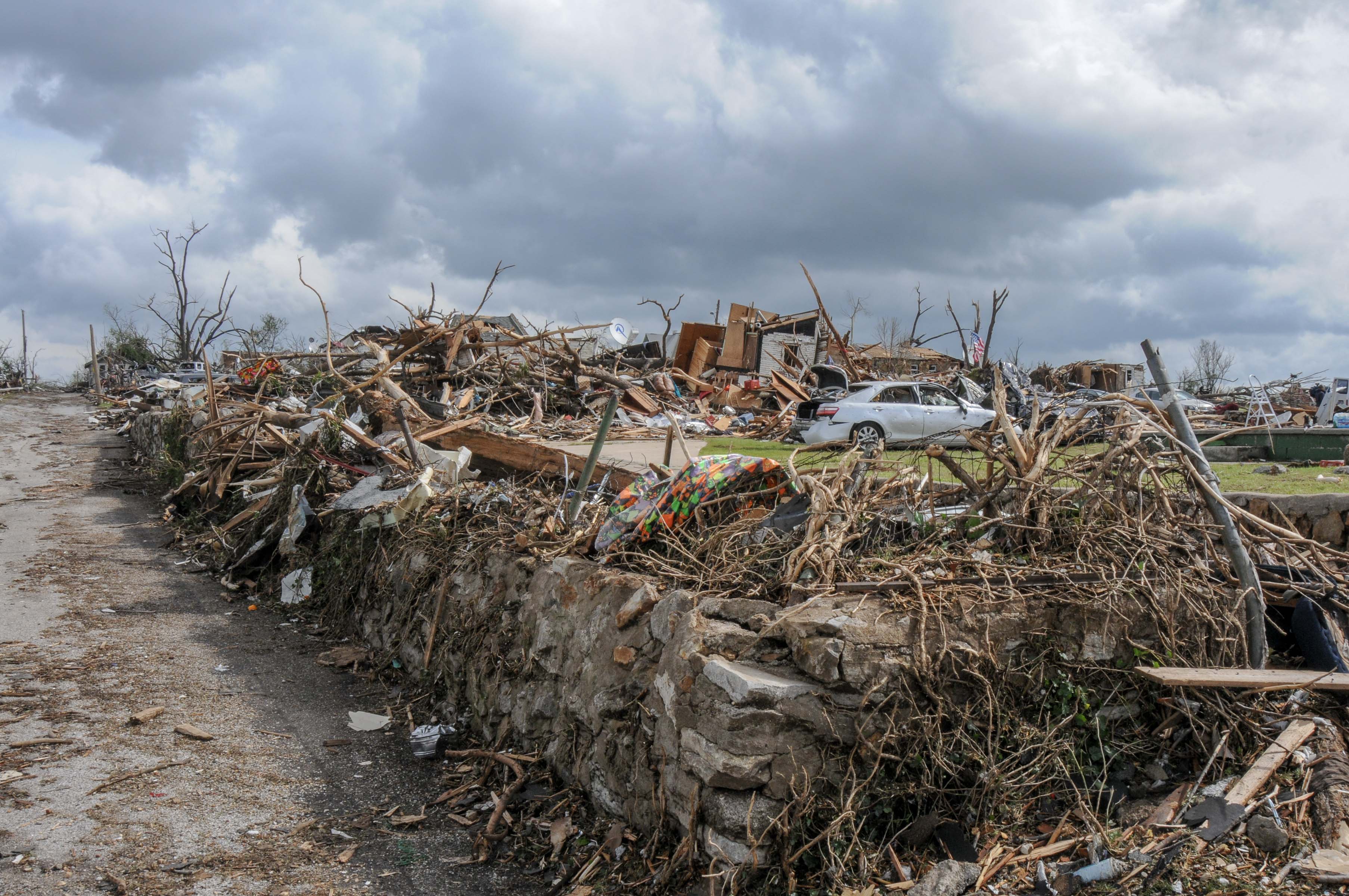
A ruined street corner in Joplin, Missouri.
A ruined street corner in Joplin, Missouri. 2011.

The first funeral was in the nearby town of Galena, Kansas on Friday for 27-year-old electrician Adam Darnaby, remembered as an avid fisherman who liked fast cars.

The first services for victims in Joplin will begin on Monday, more than a week after the tragedy, according to Dennis Dreyer, the director of operations for Ozark Memorial Park, where many the dead will be buried.

The pace of the release of the dead has frustrated families anxious to recover loved ones and to move forward in their grief. Families of only 73 of the victims have been notified so far, because officials are following a painstaking process of identification to avoid mistakes.

Lindy Molina drove in from Irving, Texas to try and find her sister and nephew. She found the nine-year-old boy safe, but neighbors said her sister, Melissa Crossley, had died protecting him from the flying debris. Molina brought pictures and tattoo references to the temporary morgue in Joplin, but had no success.

“I personally do understand the process,” Molina said. “But it is frustrating.”

While the slow release of remains has been stressful for families, it gave the funeral homes, churches and cemeteries time to prepare.

Funeral homes here have worked to pull in resources from four states to handle services for victims. They expect the state of Missouri to release remains to families at a rate of 14 to 16 a day.

A small army of part-time and former workers and volunteers will help. Anything the memorial services needed — from cars to caskets to embalming materials — were offered by the Missouri state funeral home association and from colleagues in Kansas, Arkansas and Oklahoma, funeral directors said.

Funeral homes were ready to offer private viewings, when possible, for families still wishing to say goodbye to badly damaged remains, said Tom Keckley, co-owner of Parker Mortuary & Crematory in Joplin. Medical bandages and terry cloth could cover severe injuries, he said.

“It might be looking at a hand that’s exposed while other parts are covered, but anything that will let that person know that that is their loved one,” Keckley said. “So that they accept it and can begin to heal.”

Even for funeral home staff accustomed to consoling grieving families, the Joplin tragedy has been personal. Dillon recognized names on the list of missing.

“You just hurt with them,” Dillon said. “You still have to be strong for them.”

The Ozark cemetery will be working 12 hours a day, seven days a week, said Dreyer.

His staff was still numb from the tragedy, and focused on day-to-day tasks. They held daily meetings to prepare for the overwhelming job ahead, he said.

Preparing a grave site and holding a service could take four hours, he said. Many employees had pledged to donate their time for the victims’ funerals.

“You’ll find Joplin is a close community,” Dreyer said. “From start to finish.”